For decades, networks have been designed around the assumption that traffic is unpredictable. Data arrives, the network works out where it needs to go, and switches move it towards its destination. If too much data wants the same resource at once, some of it waits.
It has proved to be an incredibly successful model. But it was designed for general-purpose computing, and AI gives us an opportunity to look at some of those assumptions again.
One of the interesting things about distributed AI is that a lot of the communication isn’t arbitrary. It comes directly from the work the system is doing.
Training and inference repeatedly coordinate groups of accelerators through collective operations such as all-reduce, all-gather and reduce-scatter. The model has been divided in a particular way. Groups of accelerators need to exchange particular data. Compute and communication happen in patterns dictated, at least in part, by the workload itself.
That leads to a deceptively simple question: what if the network knew something about what was going to happen next?
The opportunity is not simply to establish optical connections around a known workload. It is to reconfigure those connections quickly enough to follow the workload as it changes.
There is more information available than we use today
A conventional network is very good at reacting to traffic once it arrives.
But with AI, we often know more than that. We know something about the workload. We may know which accelerators are working together, which collective operation needs to take place, and which resources will need to communicate. Rather than throwing that information away, we can use it when deciding how the network should behave.
That shift is at the heart of how we think about networking at Oriole.
PRISM (Photonic Routing for Scalable Models) was designed around the communication characteristics of large AI and distributed computing workloads. The physical network, communication model, and the way connectivity is controlled are considered together rather than as entirely separate problems.
PRISM isn’t simply about replacing an electrical switch with an optical one. We’re asking a broader question: if you designed the network around what the compute is actually trying to do, what would you do differently?
Think calendars, not just queues
There is a simple analogy for some of this.
A queue deals with demand after it arrives. Several things want the same resource, so some have to wait.
A calendar is different. If you have enough information about what people need ahead of time, you can allocate that resource before the clash happens.
AI communication gives us an opportunity to bring more of that second way of thinking into networking.
If we know that a group of accelerators is about to communicate, the network can use that information to coordinate connectivity around the workload rather than simply waiting for all the traffic to arrive and sorting out contention afterwards.
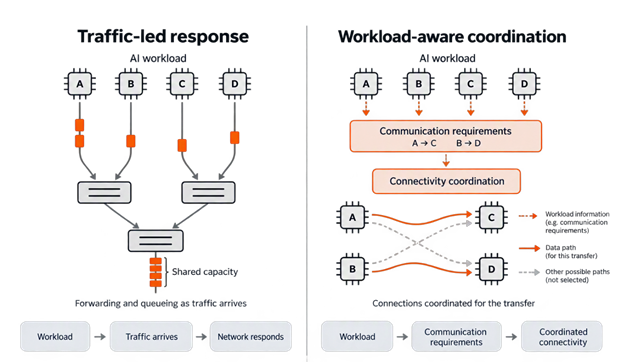
Figure 1. Workload information can coordinate connectivity, but the connection must also reconfigure quickly as the communication pattern changes.
Those allocations do not represent one long, static connection. AI communication can move through a series of short windows as the computation progresses: one group of accelerators communicates, the pattern changes, and another transfer follows. The network therefore has to do more than plan connectivity in advance. It has to reconfigure that connectivity quickly enough to keep pace.
The finer the timescale at which the optical connection can change, the more closely the network can respond to what the workload needs. Without sufficiently fast reconfiguration, workload awareness still leaves the network operating with relatively coarse, long-lived circuits.
That’s the principle. The reality, of course, is messier.
Not everything in AI can be predicted in advance. Inference can introduce dynamic behavior. Mixture-of-Experts models route tokens based on decisions made while the workload is running. Different jobs start and finish at different times. Large, sustained transfers coexist with smaller and less predictable flows.
A network designed for AI therefore has to cope with both sides of that equation: the communication we can anticipate and the traffic we can’t.
The argument isn’t that every byte of AI traffic is predictable. It’s that AI workloads have structure, and structure gives the network information it can use.
That starts to change the architecture
This gets more interesting as AI systems get larger.
Collective operations involve groups of accelerators that need to make progress together. A fast GPU waiting for data isn’t doing useful work. Neither is one that has reached the next stage of a collective and is waiting for everybody else to get there.
The obvious response has been to put more bandwidth into the network. And bandwidth clearly matters. But more bandwidth doesn’t change the underlying way the network works.
If the network understands something about the communication the workload needs, there are other things you can change.
In a conventional packet-switched network, switches along the path inspect traffic and make forwarding decisions as data moves through the fabric. PRISM moves that switching decision towards the endpoints. The endpoint knows the intended destination and determines how and when data enters the photonic network, rather than relying on a sequence of packet switches to make that decision hop by hop.
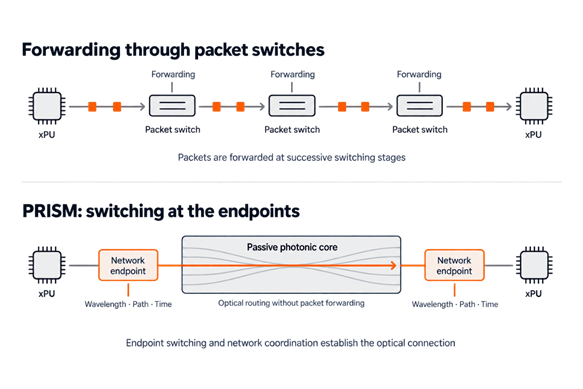
Figure 2. Moving the switching decision towards the endpoints.
The available optical connection is determined through a combination of wavelength, physical path, and time. By changing those parameters at the endpoint, the network can change which resources are connected without asking a packet switch in the middle to inspect, buffer, and forward every packet.
But the speed of that change is fundamental. The transmitter, optical path, and receiver must act as a coordinated system, making each new optical connection usable within the short window available. A network that cannot reconfigure quickly enough will still be unable to keep up with rapidly changing AI communication.
That is what moves the idea beyond a conventional optical circuit network. PRISM combines workload-aware coordination with optical connectivity that is fine-grained enough to respond to the communication needs of the AI workload. The engineering challenges that come with that will be explored in more detail in the next article.
For now, the important point is simpler. These architectural choices do not begin with the optical technology. They begin with the workload.
Start with the work, not the network
AI infrastructure is pushing almost every part of the computing stack to change.
We’ve spent years making accelerators faster and building bigger clusters around them. As those clusters grow, connecting the compute efficiently becomes part of the compute problem itself.
That makes this a good moment to revisit some very old networking assumptions. Perhaps the challenge isn’t only to build faster networks. Perhaps it’s to build networks that know more about the work they’re being asked to do.
That’s where we started with PRISM.